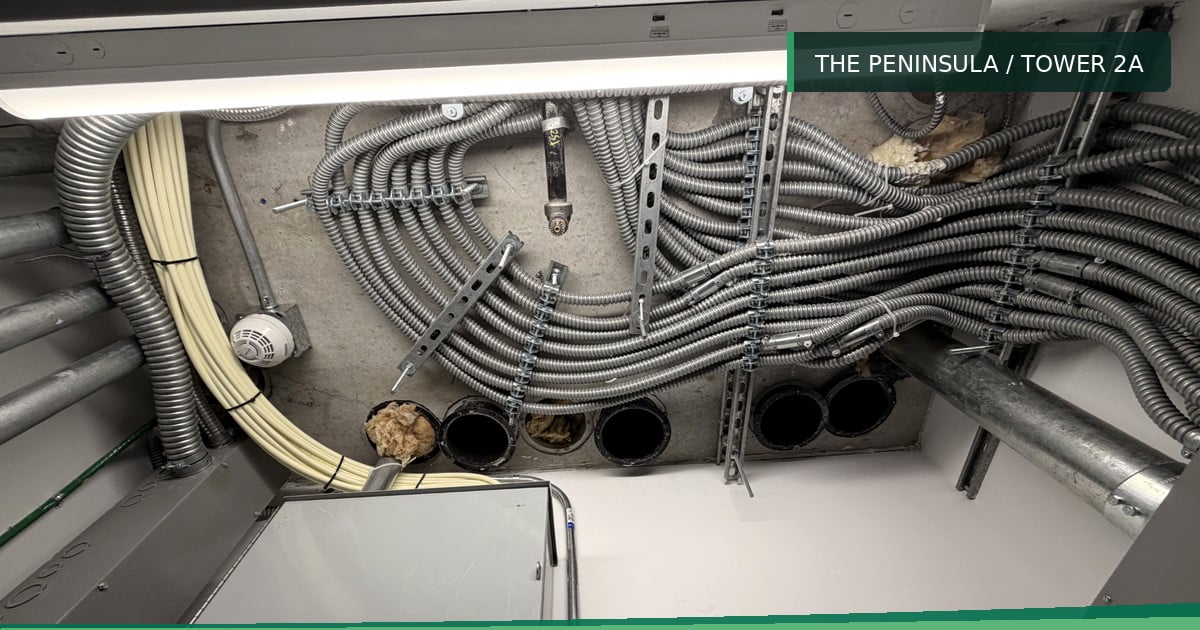
“Future-proofing” gets thrown around a lot in the construction and smart building industries. At Techmenity, we prefer the term Future-Ready. It's the philosophy behind our Future-Ready Building Method.
Future-proofing suggests we can predict what technology will look like tomorrow. Future-ready means preparing the infrastructure today so the building can adapt to whatever comes next.
Here's a practical example:
If a building owner wants to bring in a new internet service provider five years from now, will they need to open finished walls and ceilings to run new cables? Or will the infrastructure already be there to accommodate them?
That difference comes down to decisions made long before anyone moves into the building.
Start with the infrastructure that's hardest to change.
Network equipment, software, and connected devices will evolve. That's a given.
But the physical infrastructure that supports them — conduit, cabling pathways, telecom rooms, and vertical risers — is much harder and more expensive to change once construction is complete.
This is why we encourage project teams to think of connectivity as a core building utility, planned alongside power, plumbing, and HVAC.
At Techmenity, we call this the Digital Foundation™: the physical and network infrastructure that allows a building's connected systems to operate efficiently today and adapt as technology changes.
And some of the most important decisions are surprisingly simple.
1. Give the building control over its infrastructure.
Internet service providers often install infrastructure specifically for their own services. That may work perfectly well today, but it can create limitations when a building wants to introduce another provider or upgrade its connectivity.
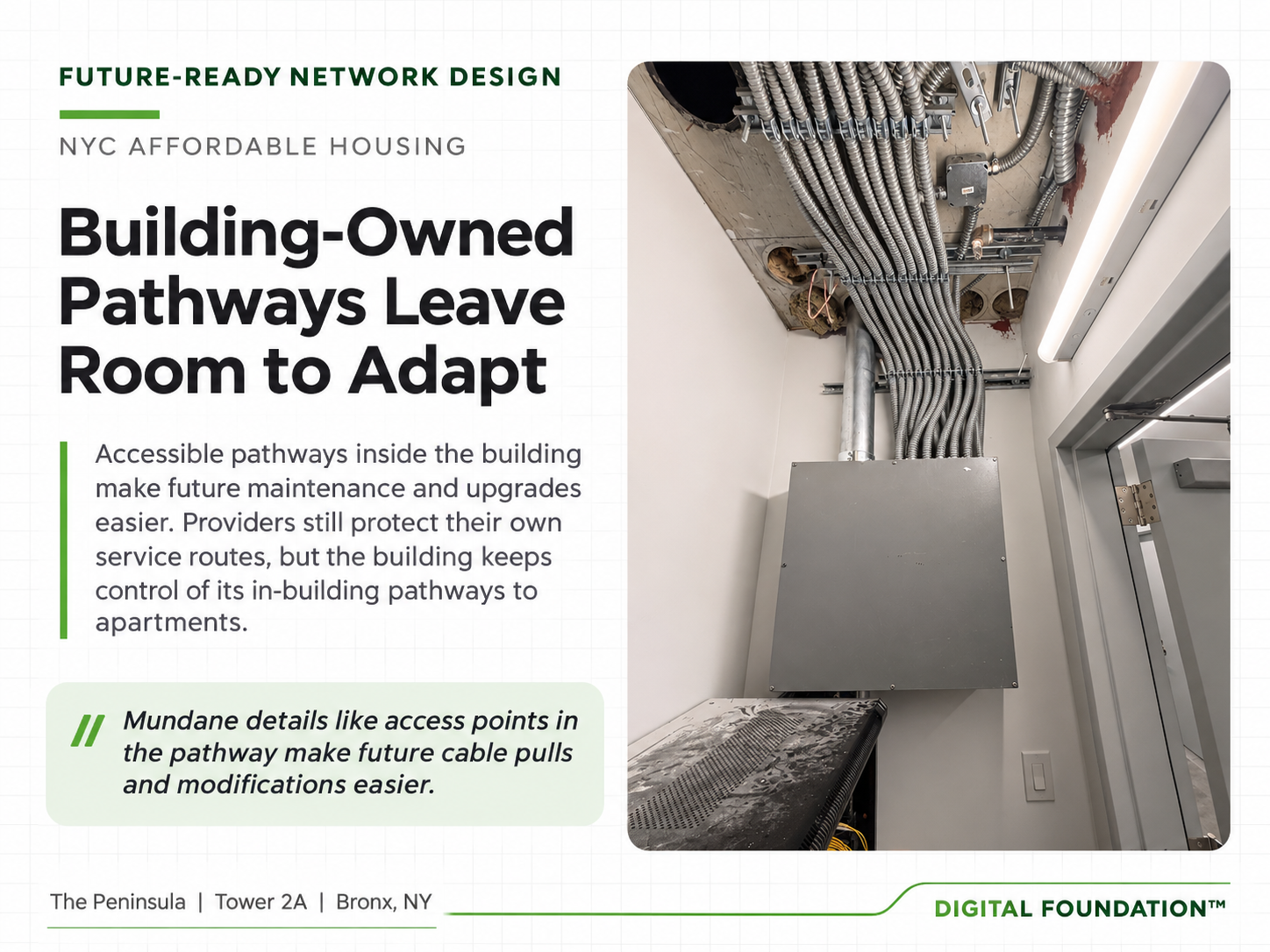
A Future-Ready design distinguishes between building-owned pathways and those dedicated to individual internet providers.
Building-owned pathways into apartments give property owners control over infrastructure they may need to modify, expand, or upgrade. Providers such as Verizon, Spot On, and Comcast maintain their own protected routes so they can manage and service their networks independently.
That separation gives the building flexibility without compromising the providers' ability to operate their systems.
2. Plan how connectivity will reach every space.
Let's use The Peninsula, a major affordable housing development in the Bronx, as an example.
Techmenity was brought in by EP Engineering to design the network infrastructure supporting broadband service across the project's residential towers.
New York City's HPD Broadband Guidelines establish connectivity requirements for applicable affordable housing developments. Our job was to design the infrastructure that would support those requirements while leaving room for future service options.
For Tower 2A, we designed a system that distributes connectivity throughout the building:
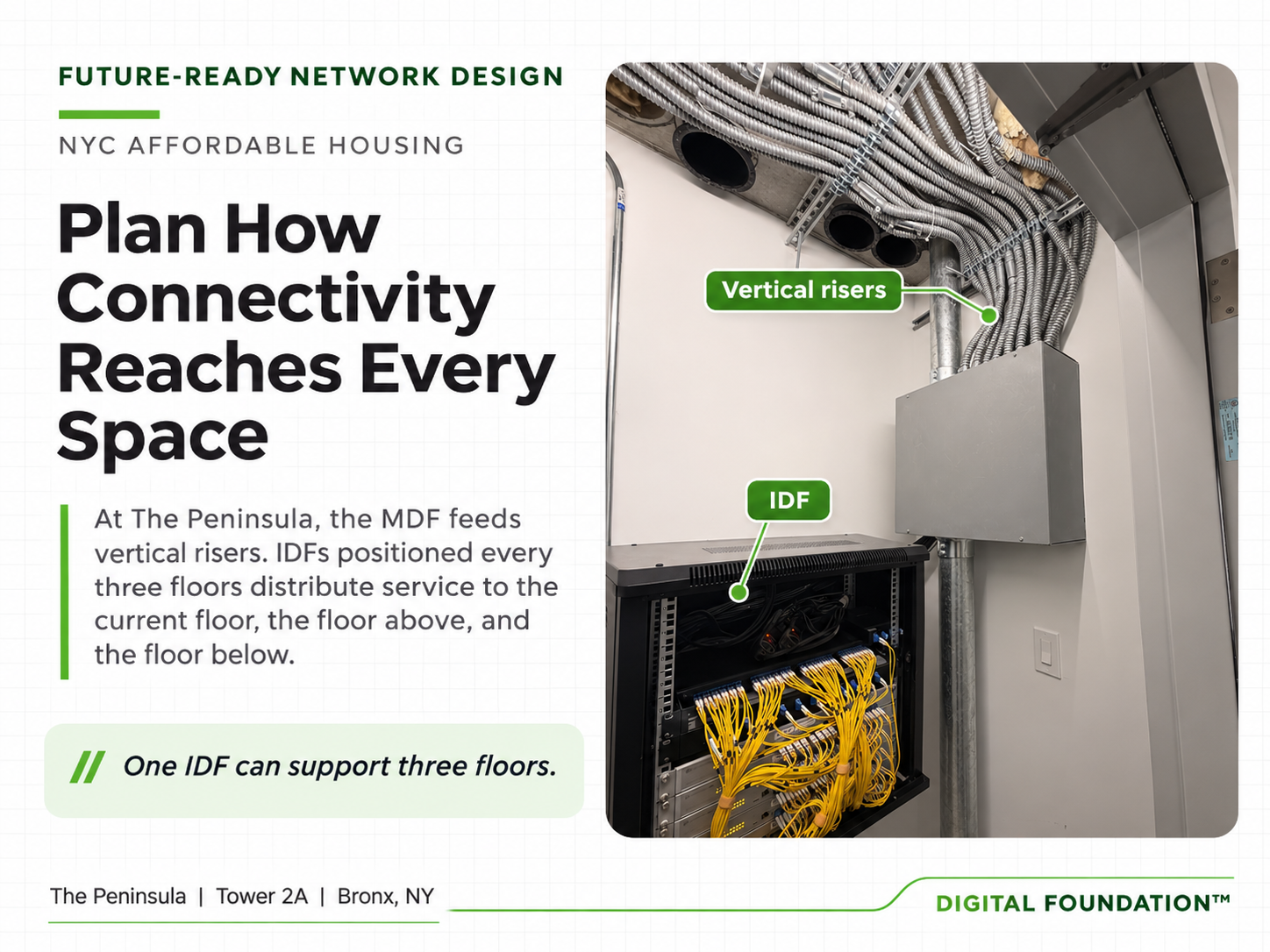
The MDF (Main Distribution Frame) is the central distribution point where incoming services connect to the building.Vertical risers carry cabling between floors.
IDFs (Intermediate Distribution Frames) positioned every three floors provide local distribution points, serving apartments on their own floor and the floors above and below.
Dedicated pathways connect those distribution points to individual apartments.
The Peninsula also presented an interesting design decision: two towers under one ownership, with a single incoming ISP connection.
Rather than building two independent MDFs unnecessarily, we designed one shared distribution facility while reserving additional conduit from the street. If the towers are ever sold separately, the second building can establish its own MDF and independent service connection without having to rebuild the underlying infrastructure.
That's what future-ready design looks like: meeting today's needs without limiting tomorrow's options.
This is particularly relevant to affordable housing, where developers and owners often expect to hold and operate their properties for decades. Unlike developers planning a near-term sale, long-term owners have a stronger incentive to invest in infrastructure during design because they'll actually benefit from the operational efficiencies and avoid upgrade costs over time.
3. Know what can change without compromising the design.
Future-ready design doesn't necessarily mean using the most expensive solution. It means knowing which elements need to be preserved to protect the long-term vision.
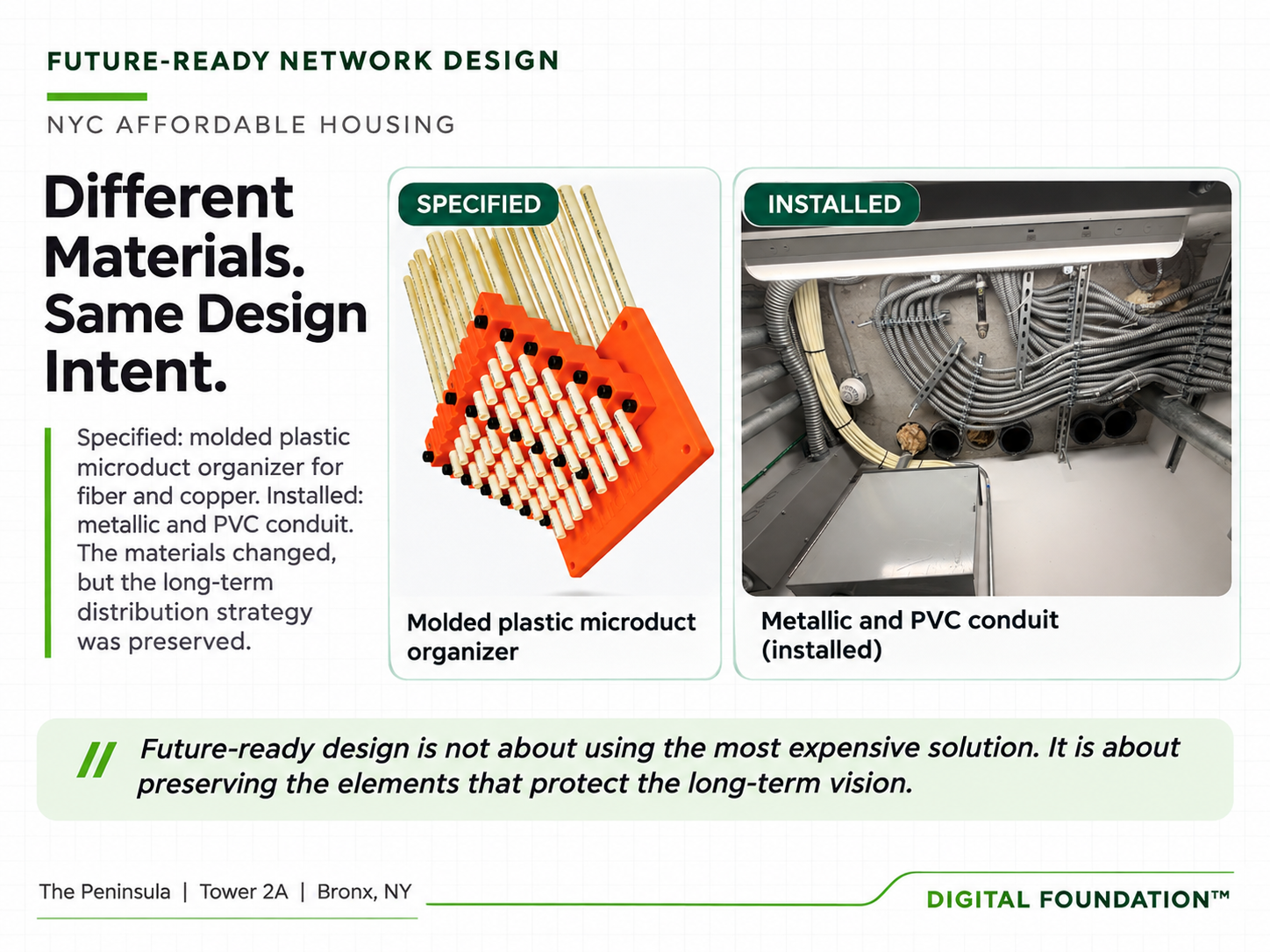
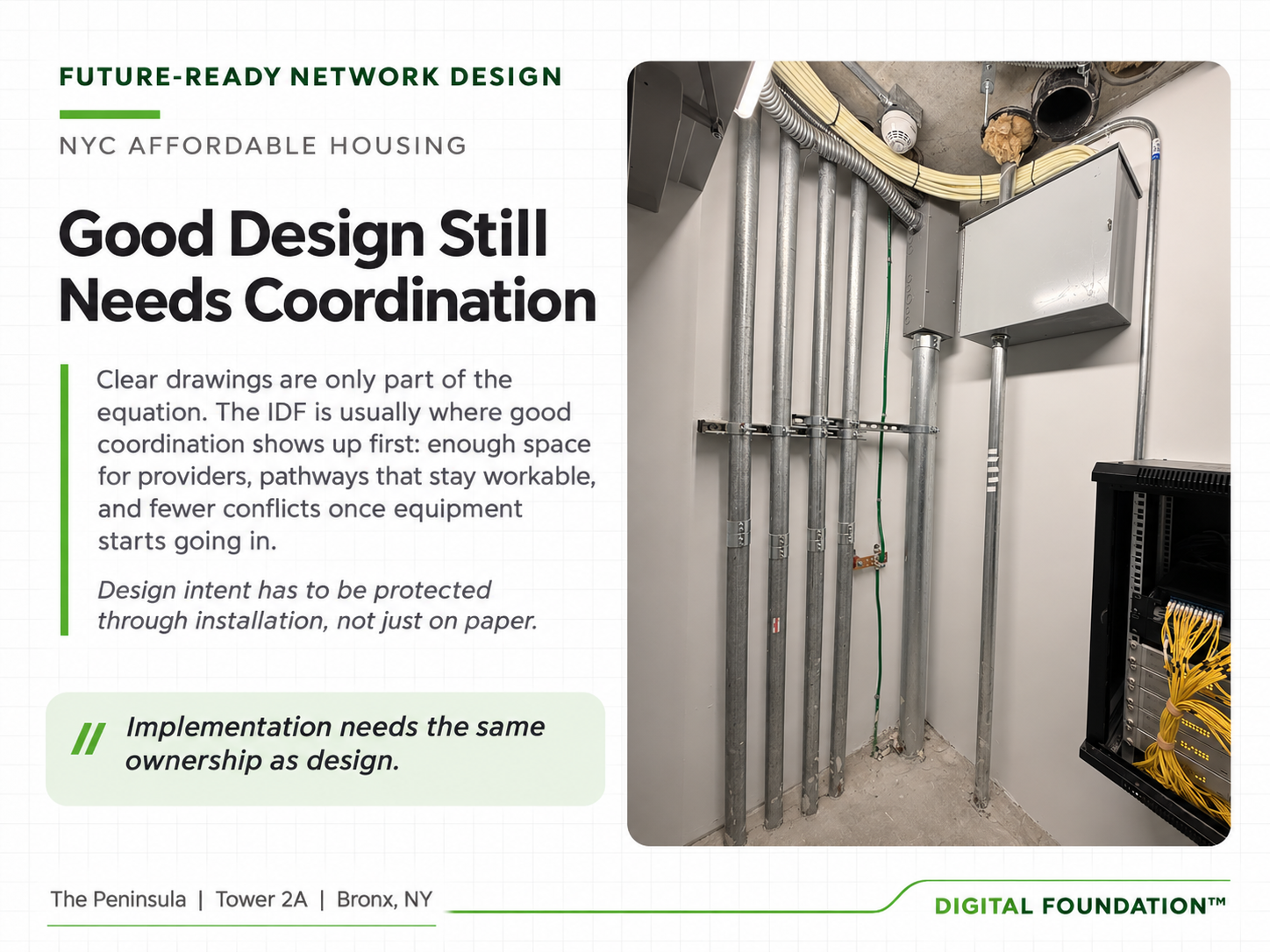
At The Peninsula, our original design included modular plastic components to organize cabling pathways. During value engineering, the project team substituted a more economical flexible metallic conduit solution.
But the important part wasn't the material swap itself. It was that the project team understood the original design intent and which elements needed to be protected.
A big part of the TechGC role is education. Helping owners, engineers, GCs, subcontractors, and vendors understand where their systems intersect, why certain design decisions matter, and what questions to ask before making changes.
The Peninsula team deployed different materials but protected the underlying distribution strategy.
That's the value of good technology planning and collaboration: knowing where you can reduce costs without sacrificing the functionality that makes the infrastructure valuable in the first place.
4. Give implementation the same ownership as design.
Of course, understanding the design is one thing. Executing it is another.
Multiple contractors and internet providers may work in the same telecom rooms, use the same risers, and connect equipment to the same underlying infrastructure. Each may be responsible for its own piece, but who's making sure all those pieces work together?
That's why a Technology General Contractor (TechGC) is essential to the process. Someone needs to coordinate the technology trades, protect design intent as field conditions change, and maintain accountability through testing and turnover.
At The Peninsula, Techmenity was engaged for design, not construction administration. We were later brought back under a separate engagement to assess whether the installed systems reflected the original design intent.
Our assessment confirmed working connectivity at sampled locations, and there's still time to address the additional items requiring attention before final acceptance.
But it reinforces an important point: a well-designed Digital Foundation™ needs equally thoughtful management during implementation.
Future-ready is both a design decision and an execution responsibility.
You don't need to predict which technologies a building will use in 2035.
You do need to plan the pathways, space, and capacity that will accommodate them — and make sure someone is accountable for carrying that plan through construction.
That's the thinking behind Techmenity's Future-Ready Building Method: technology needs to be considered early, coordinated across disciplines, and managed through implementation and beyond.
So before the walls close, every project team should be asking two questions:
Are we building infrastructure that leaves us options for the future?
And who's responsible for protecting those options during construction?